073 060 59 89
Types of AD campaigns
 03.12.2025


Almost every business needs online advertising these days if it wants to grow steadily rather than wait for “something to happen.” But the problem is that there are so many formats, it seems like everything is being advertised everywhere, and it’s unclear what exactly you need.
Contextual, targeted, and banner advertising work differently and have different effects. Sometimes it is important to quickly catch people who are already looking for a product or service, sometimes it is important to introduce the audience to the brand and gradually lead them to a purchase, and sometimes it is important to simply be visible so that people remember you. In this article, experts from digital marketing agency Cómon Agency will explain the different types of advertising campaigns, what each one is for, and how to choose the option that will bring real results in your situation.
We are all used to spending most of our day on our phones: reading news in messengers, scrolling through social media feeds, communicating, watching short videos. In other words, it can be said that people now literally “live” in digital channels, and that is where businesses can find them. Therefore, online advertising is no longer an “additional tool” but has become the main way for businesses to promote themselves, find customers, and keep in touch with them. And when the digital market occupies almost all of the country’s advertising space, companies simply have no other option — they need to be where people’s attention is focused.
But online advertising does not work on a “set your budget and wait” basis. Each platform has its own rules, and the system responds to the signal you give it. And if the target is chosen incorrectly, advertising can attract the wrong people, lead to the wrong actions, and quietly “eat up” the budget without providing any benefit. Therefore, it is very important to build the right strategy to direct money to where it turns into applications, sales, and real customers. This, as you understand, saves time, nerves, and budget.
So, let’s talk about advertising campaigns, what they are, and how they help businesses operate confidently and predictably in the digital environment.
There are definitions from textbooks, there are definitions from Google guides, and there is the one that people who run ads every day really understand.
Simply put, a good advertising campaign is a pre-planned series of ads that are based on a single idea, a clear goal, and your understanding of who exactly you want to show something to. A campaign only works when it is tailored to a specific audience, on selected platforms, with a defined budget and well-thought-out metrics.
Goal. The goal must be clear and linked to real business results.
For example, not “I want more reach,” but “I want to increase online sales by 20%.” After that, the platform optimizes impressions specifically for this action.
Audience. In Meta, the audience is set up by age, gender, interests, behavior, or your own customer lists, and in Google — through special segments, interest categories, and remarketing.
Budget. In Meta, you can set your budget at the campaign or ad set level, depending on whether you want the algorithm to allocate funds itself or you want to control it manually. In Google, you set a daily budget, but the system can use more on certain days if it sees potential results.
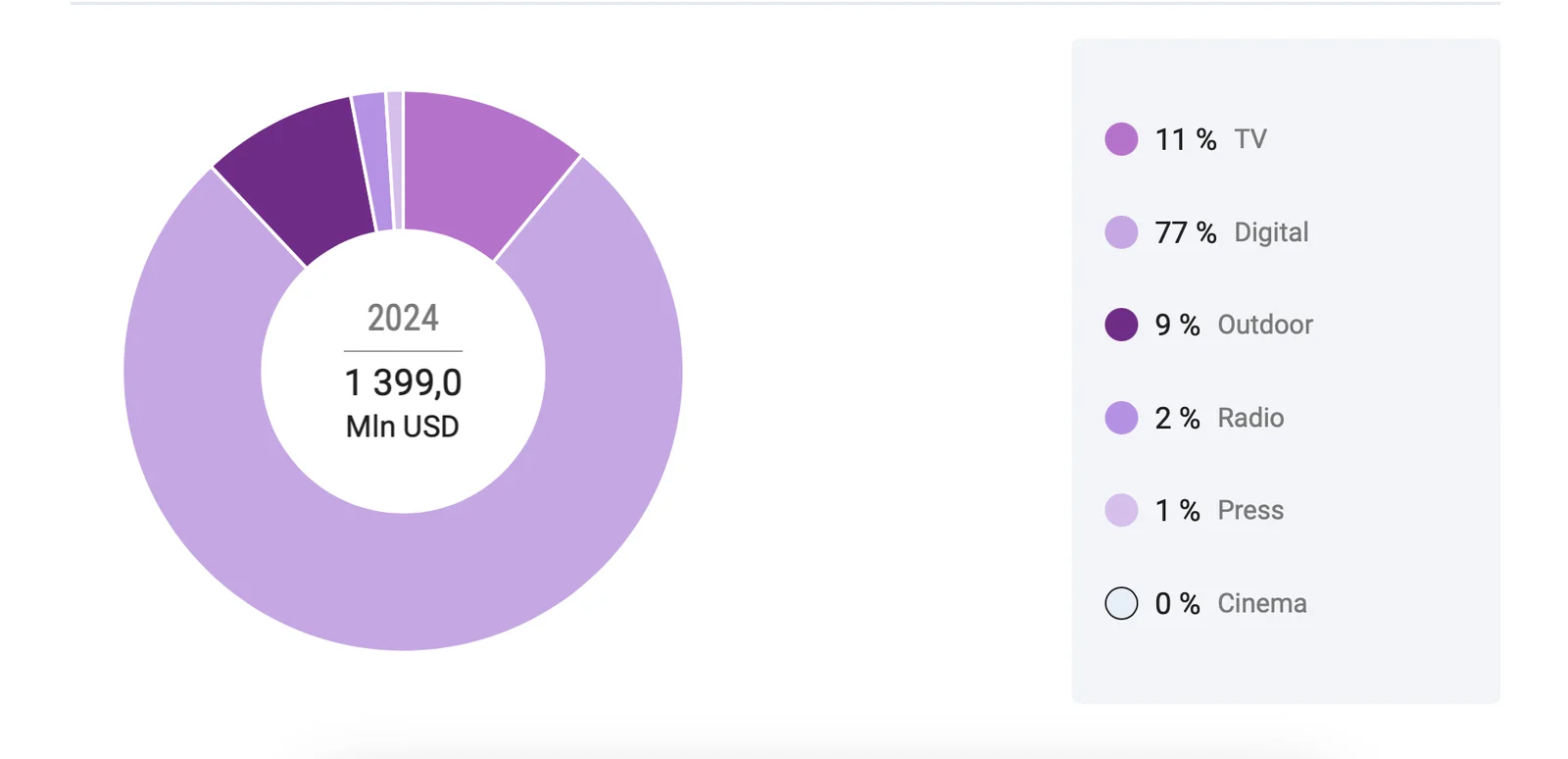
Platforms. According to VRK, digital advertising accounts for over 77% of the market. This means that online advertising provides the best chance of finding customers. Television, radio, and outdoor advertising remain additional tools.
Analytics. Platforms provide a huge set of metrics: number of impressions, reach, cost per click, conversion rate, return on ad spend, and much more. Based on this data, decisions are made about budget, creatives, audiences, and formats. In other words, analytics show what works and what needs to be changed.
Today, the main set of working tools for businesses includes:
Let’s take a closer look at each type separately.
These are ads that appear in search results when a person enters a query such as “buy an inverter in Kyiv.” In other words, the user is already looking for something, and you appear on the screen at that very moment.
Google describes Search Ads as a way to show your business to people who are already actively looking for a specific product or service. The format is usually text-based (sometimes with additions such as links, numbers, images), and ads appear above or below organic results.
1.Keywords. You set a list of key phrases (for example, “buy inverter Kiev” or “dentistry Obolon”), and the system matches the user’s actual query with your keywords.
2.Auction. Each search query triggers an internal auction. Google takes into account the bid, the relevance of the ad and the page, the expected probability of a click and conversion, as well as the quality of the landing page. Based on this, an Ad Rank is formed, which determines whether the ad will appear and in what position.
3.Automation and AI. In recent years, Google has been actively promoting automatic bidding strategies and formats such as Performance Max. You set a goal (e.g., sales), budget, and creatives, and the system selects combinations of impressions, keywords, and auction settings.
Contextual advertising works best where demand already exists:
Advantages:
But there are also disadvantages: if no one is looking for your product, there will be few impressions, and in competitive niches, the price per click can be high.
These are banners, videos, and other visual formats that appear on websites, in apps, and on platforms such as YouTube. They can work both to increase awareness and for remarketing. Display advertising is described as visual ads that lead the user to a website or landing page.
When to use:
Advantages:
However, this type of advertising does not always have a quick effect in terms of sales and usually requires strong visual creatives.
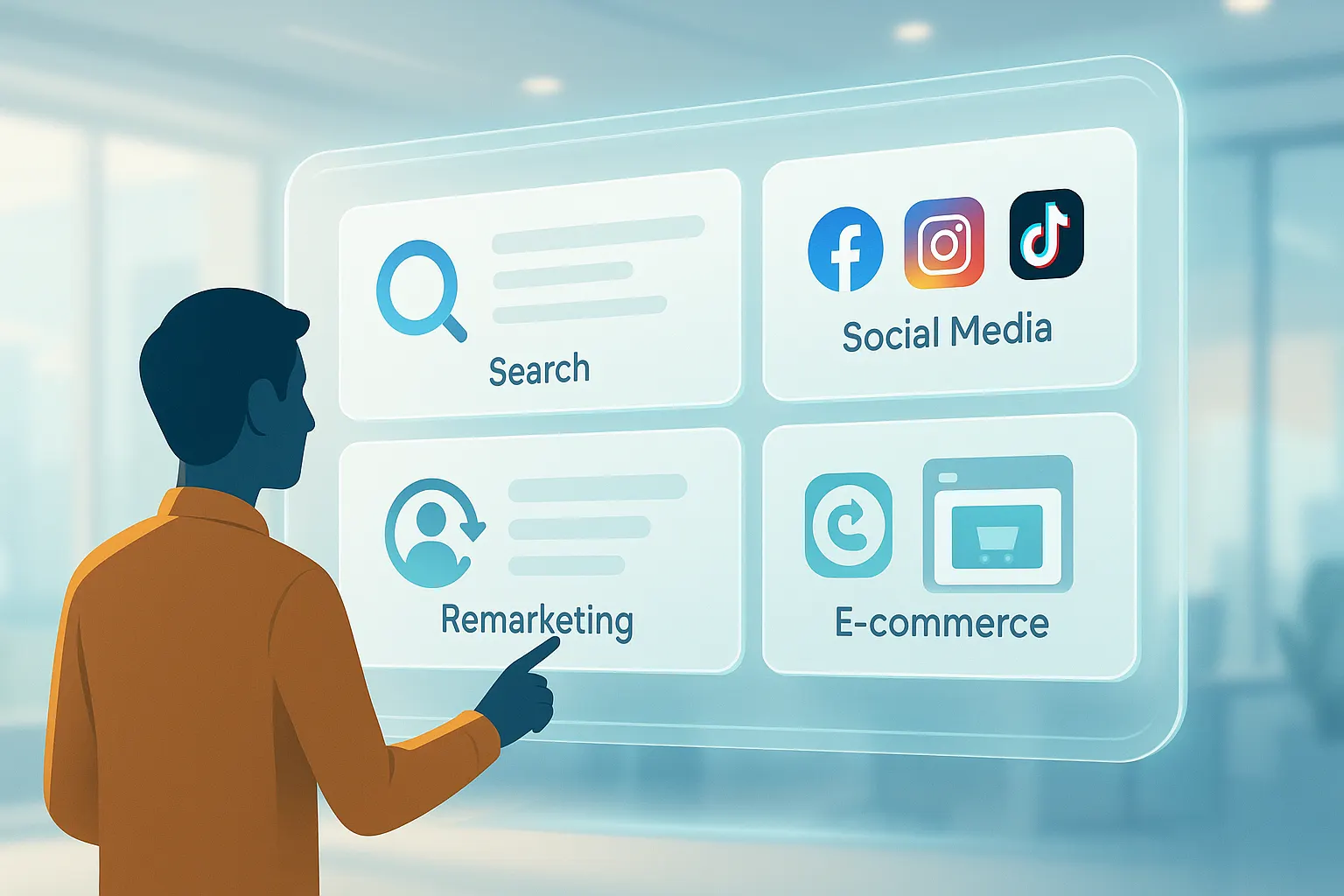
These are ads that are shown to users in their feed, stories, reels, or recommendation feed. Platforms use their algorithms to decide what to show to whom.
These platforms have a significant audience in Ukraine:
Meta (Facebook, Instagram). Meta’s advertising system combines auction and machine learning. The algorithm predicts how likely a particular user is to perform a target action — a click, registration, or purchase. To do this, it takes into account many signals: previous behavior, interactions with content, device, time of day, and more. In recent years, Meta has been moving toward broader audiences and strong creativity, while excessive targeting detail is losing its effectiveness.
TikTok Ads. TikTok works with:
Targeted advertising on social media accomplishes several tasks at once:
When to use:
Advantages:
Limitations: much depends on the quality of the creative content, and algorithms change, so campaigns need to be reviewed regularly.
This involves showing ads to people who have already interacted with the brand but have not taken the desired action: they have not made a purchase, filled out a form, or completed registration.
Google Ads describes remarketing as showing ads to website visitors or app users that you collect in special lists. These can be search campaigns as well as media and video formats.
Dynamic remarketing is often used, where the product that the person viewed is advertised.
When to use:
Advantages:
However, it should be noted that remarketing is affected by privacy rules and transparency requirements for online advertising.
For online stores, there is a separate layer of advertising — formats that work directly with product feeds. The user immediately sees not just a general ad, but a specific product with a photo, name, and price.
This includes Google Shopping, Performance Max for e-commerce, social media stores (Facebook/Instagram Shop), and other catalog-based solutions.
Google Shopping displays product ads with photos, names, prices, and store names. The data is taken from the Merchant Center feed. These ads usually appear above or to the side of text search results, especially for queries in the format “buy + product.”
According to agencies, this format has become one of the main tools for promoting online stores, especially those with a wide range of products.
When to use:
Advantages:
Meta allows you to create a store on Facebook and Instagram, upload a catalog there, and direct people either to the Shop itself or to the website.
Meta uses its algorithms to make the user’s path to purchase as short as possible.
When to use:
Advantages:
These five areas are the basis on which Ukrainian businesses, from small online stores to large brands, operate. But how do you know which one is right for you?
To find out what type of campaign is right for your business, you first need to decide what you consider to be a result — a sale, an application, a visit to your website, or audience reach? In Google Ads and TikTok Ads, it works the same way: the system literally “tunes your brain” to the selected goal and starts looking for people who are prone to this particular action.
Sales. If it is important for you that people not only visit your website but also actually buy something, then you should go for sales-oriented campaigns.
In Google Ads, these are goals such as “Sales,” where the system looks for those who usually complete the action (leave payment or complete the order). TikTok works the same way: for the “Conversions” type, you need a pixel that sees that a person has made a purchase and allows the algorithm to learn from these actions.
Important: this is appropriate when you have a website, online payment, or a clear buyer journey.
Applications. If it is important for a business to obtain contact information (phone number, form, message in a messenger), it is worth launching lead campaigns.
TikTok allows you to collect contacts directly on the social network or lead people to Direct or messengers, while Google Ads focuses on actions such as “submit an application” or “subscribe.”
This is suitable for the medical, service, education, repair, and B2B niches — in short, anywhere where sales are made by a manager rather than a website. But it is important to have at least a minimal application processing cycle: who calls, when, and how they check quality.
Traffic. This goal is necessary when you want to bring people to your website but don’t expect them to take any specific action. It is useful when the website is new, when you need to collect initial data for the pixel, or when the number of conversions is too small for full-fledged training.
In this case, Google Ads optimizes the campaign for clicks. TikTok also works this way: it does not evaluate what will happen after the click, it simply brings people where you asked them to go.
Recognition. When a business enters a new territory, launches a new product, or simply wants to increase awareness, it runs campaigns for reach and views.
TikTok optimizes such campaigns for maximum reach or for users who actually watch videos rather than just scrolling through the page. Google Ads focuses on branded formats (banners, videos, reach).
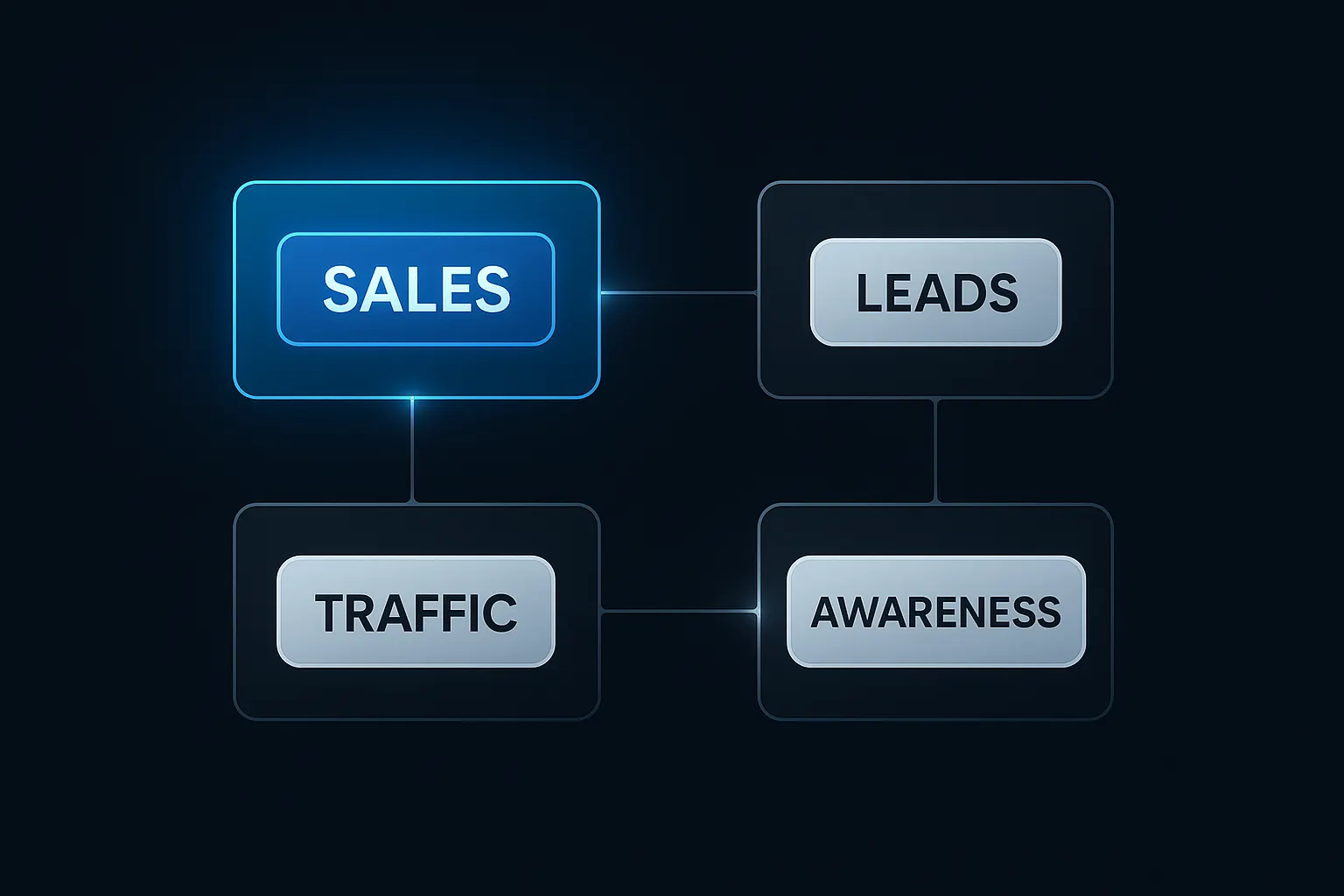
In practice, businesses get better results when they combine campaign types rather than relying on just one. When brands work simultaneously at different stages of the funnel — reach, mid-funnel, and bottom-funnel — their ROI grows more significantly than when they focus on just one thing.
TikTok also encourages this approach: for example, Lead Generation is considered a universal tool that is suitable for both “top” introductions and “bottom” collection of hot contacts.
If you don’t want to deal with algorithms, technical nuances, and endless settings, that’s okay — there are people who do this every day.
The experts at Cómon Agency will help you choose the optimal strategy for your specific business. Our team analyzes your business, looks at which goals make sense, which tools will work in your niche, and puts together a strategy so that your advertising doesn’t waste your budget but brings real results.
At Comon Agency, we have been operating since 2018 and are well aware of how Ukrainian digital has changed. We witnessed the period when businesses were just trying to work online, saw a sharp increase in competition, forced transitions to digital, and the constant movement of audiences between platforms. Over the years, we have learned to build advertising systems that consistently generate leads, sales, and subscribers, even in challenging conditions.
1. We work with real numbers, not “reach”
Our projects involve a wide variety of tasks, from sales in a women’s clothing store to mass lead generation. We brought a clothing store $10,000 in revenue from a budget of $1,755, made over 1,000 applications for a recruiting company at $1.25 each, received over 25,000 leads in the dating sector, and in the niche of education abroad — almost a thousand applications in a short period.
2. We have experience in completely different categories
Clothing, cosmetics, recruiting, education, food delivery, psychology, local events, alcohol retail, e-commerce — we see how audiences behave in different topics and transfer the best tools between niches. Thanks to this, clients receive solutions that really work in their field.
3. We work through analytics
An integral part of our daily work is GA4, Performance Max, Shopping campaigns, correct goals, Smart Bidding, and signals for algorithms. We work with data so that advertising always gives predictable results and allows for scaling.
4. We use automation where it makes campaigns stronger
Artificial intelligence in link building, automated Telegram funnels, correct work with feeds, tools for searching sites, automation of communications, testing of creatives — all this makes advertising faster, more accurate, and more effective.
5. We create creatives that help sell
For us, creative is a well-thought-out approach to content, tone, and presentation that helps businesses attract people and keep their attention. This looks different in different projects: in some cases, we gathered a large audience in the psychology niche, in others we worked with local brands or festivals, and in others we created content for retail chains.
All of this works together with advertising as a single system, where each element supports the other and enhances the result. And clients continue to work with us because they see that everything is based on a systematic approach.
If you need a team that works honestly, transparently, and with a focus on results, you’ve found it)


 28.04.2025