0 800 335 278
How much does it cost to promote an online store?
 10.11.2025
Tenders and partnerships
team@comon.agencySales department
sales@comon.agency


Online commerce has become one of the most stable sectors of the economy in our time. According to the National Bank of Ukraine, 94.6% of all transactions last year were cashless, with online purchases bringing in over UAH 622 billion. Nova Poshta alone delivered almost half a billion shipments in a year, and marketplaces such as ROZETKA and Prom.ua are breaking traffic records.
Why is this? Because people have become accustomed to the convenience and speed of online shopping, without having to wait in line, and purchases have smoothly transitioned to mobile phones. Bank cards work without a hitch, and delivery services manage to transport everything from books to washing powder to any city. This is our modern daily e-commerce: it is based on payment infrastructure, stable logistics, and the habit of buying online, which has taken root even during the war.
Simply having a website or social media page does not guarantee sales. To be found among dozens of similar stores, you need visibility in search results and feeds, well-thought-out creative content, customized analytics, and control over the cost of each customer attracted. When a business invests in advertising, it is essentially buying traffic and user time, and then conversion decides whether the page is convenient, the offer is clear, and there is trust. At this stage, it is promotion that brings in money — it attracts the right audience and allows you to calculate the result in concrete figures (customer cost, return on investment, repeat purchases, etc.).
Next, we will look at how much it costs to promote an online store in Ukraine and how best to do it.

Store size and theme
The larger the store, the more work is required to showcase it to people. If you have a few products, you can get by with a small budget and promote each one separately. But if your catalog is large (hundreds of products), you need a bigger budget to cover all items, test ads, and maintain feeds (i.e., automatic lists of products for advertising).
In other words, a small niche store can be promoted on a budget that is just the price of a cup of coffee a day for a large marketplace. But a large catalog is not a disadvantage, but an opportunity to scale up if you learn how to allocate resources wisely.
In addition, demand for online shopping continues to grow, which means that competition is only getting tougher. And if your products are in a popular category, advertising will cost more because dozens of businesses are competing for the buyer’s attention.
Niche competitiveness
In advertising systems, everything works through an auction. Google, Meta (Facebook, Instagram), or TikTok decide for themselves who to show ads to. And it’s not the one who bids the highest amount who wins, but the one whose ad is high-quality, understandable, and really interesting to people.
Advertising campaigns are becoming more and more numerous, which drives up the cost of impressions. And if your niche is popular, the price per click or per purchase may be higher. To get results, you have to not only pay, but also constantly update your creatives, test your audience, and analyze what works best.
Promotion goal
The cost of advertising also depends on what goal you set. If you just want to attract people to your website, that’s one thing, but if you need to sell right away, that’s another story.
Meta, Google, and TikTok tailor their ad displays to your goals, but for advertising to really learn how to find buyers, you need to give it time and enough data. In practice, this means that the budget for “sales” is always larger than for ‘traffic’ or “brand awareness.” In other words, you pay not only for impressions, but also for the system’s learning process. Therefore, if you want to get results quickly, you will have to invest more money.
Choosing promotion channels
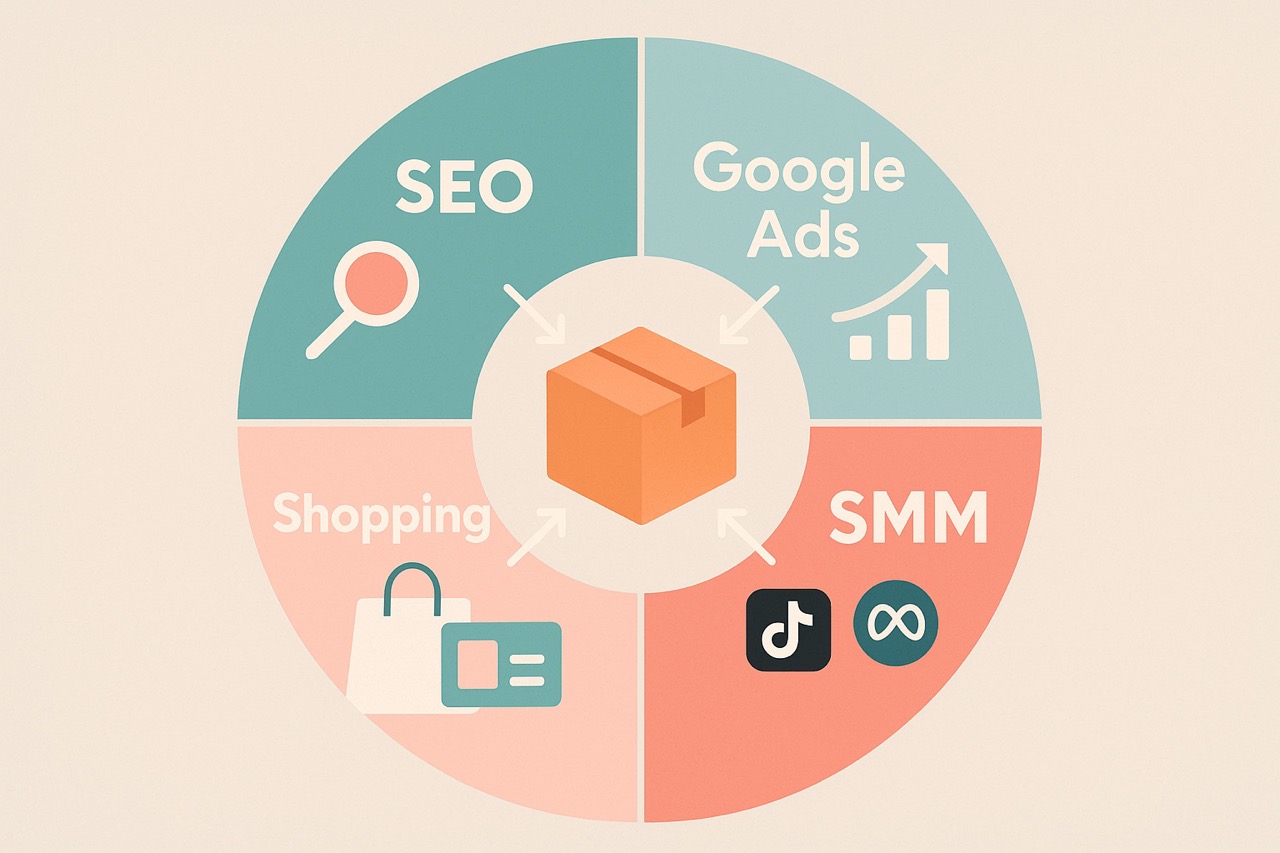
There are several main areas of promotion, and each has its own costs.
SEO is a long and ongoing process involving work on the website itself (speed, structure, texts, usability). The results of this work are not immediate, but they are stable.
Google Shopping or Performance Max are suitable for stores with a large assortment. Here it is important to correctly configure the product data (the so-called feed).
Meta (Instagram, Facebook) is the most flexible option for local businesses. Here, high-quality creatives, correct audience settings, and accurate analytics are important. If the system sees that people are actually buying, it will optimize advertising for such users on its own.
TikTok Ads — very fast results, but you need a budget for testing. The platform requires a minimum of $50 per campaign for the algorithm to start working. The main thing here is to create videos that look like regular (and interesting!) content, not commercials.
First, the team checks the website technically: indexing, speed, Core Web Vitals, errors in structure. Then it collects semantics, tidies up the catalog and cards, sets up internal links, prepares a content plan, and gradually builds a “clean” link profile. You receive regular reports: what has been done, how it has affected traffic and positions.
Payment can be one-time for an audit, monthly for maintenance, or hourly. Money benchmarks:
At the beginning, focus on technical cleanliness, and then on updating key pages and planning reports on positions and organic sales.
Contextual advertising in Google Ads
First, we design the logic of the campaigns, select keywords and negative keywords, write ads, connect conversions in GA4, and add remarketing. Then, the team reviews search terms weekly, adjusts bids and creatives to ensure that expenses work for the order.
Payment models — one-time setup and monthly maintenance or a percentage of the budget. Prices:
You can check the actual price per click and application yourself using your own data for the first 4-8 weeks.
Product advertising: Google Shopping and Performance Max for Retail
To display products with prices and photos, prepare Merchant Center and a product feed with complete attributes, link it to Google Ads, set up PMax, and monitor diagnostics. If the feed is incomplete or contains errors, impressions will be cut or become more expensive, so data discipline is crucial here.
Cost of work:
There are two parallel areas here: content and media buying. First, the content format is agreed upon (reels, stories, static posts), then a pixel or SDK is placed, events are set up for the shopping cart and purchase, campaigns are launched for different stages of the funnel, and weak creatives are removed weekly.
Approximate costs:
Minimum platform budgets:
Comprehensive internet marketing
This format combines SEO, Google Ads, Shopping/PMax, and social media into a single system with transparent analytics. First, goals are set in numbers, audience segments, and priority categories. Then, a media plan with budgets is drawn up, GA4, attribution, and dashboards are set up, and regular experiments and work on website conversion are carried out.
The budget ranges are as follows:
Small store. For example, you have a small store with a monthly revenue of 300,000 to 1 million hryvnia. For advertising to really work, it makes sense to invest about 7-12% of your earnings in it. That’s 21,000 to 120,000 hryvnia per month.
How this money is distributed:
If it’s a complex niche (clothing, cosmetics, gadgets) or you want to grow faster, it’s better to aim for the upper limit (100-120 thousand).
An average store has higher revenues, usually ranging from 1 to 5 million hryvnia per month. Marketing costs around 70-600 thousand hryvnia. It sounds like a lot, but at this stage, the business is no longer just “advertising” itself, but systematically working with data and customers.
Here’s what it looks like:
If you want to scale up, i.e., expand to other cities, test new formats, or actively work with video, plan for up to 10-12% of your income.
Large store. Here we are talking about 5-30 million hryvnia per month and more. The marketing share is the same (7-12%), i.e. approximately 350,000 to 3.6 million hryvnia per month.
How this money is spent:
Answering the question “How much does it cost to promote an online store?” is like answering the question “How much does it cost to build a house?” right away. After all, the answer is the same in both cases: it depends on many factors, and the price is never the same.
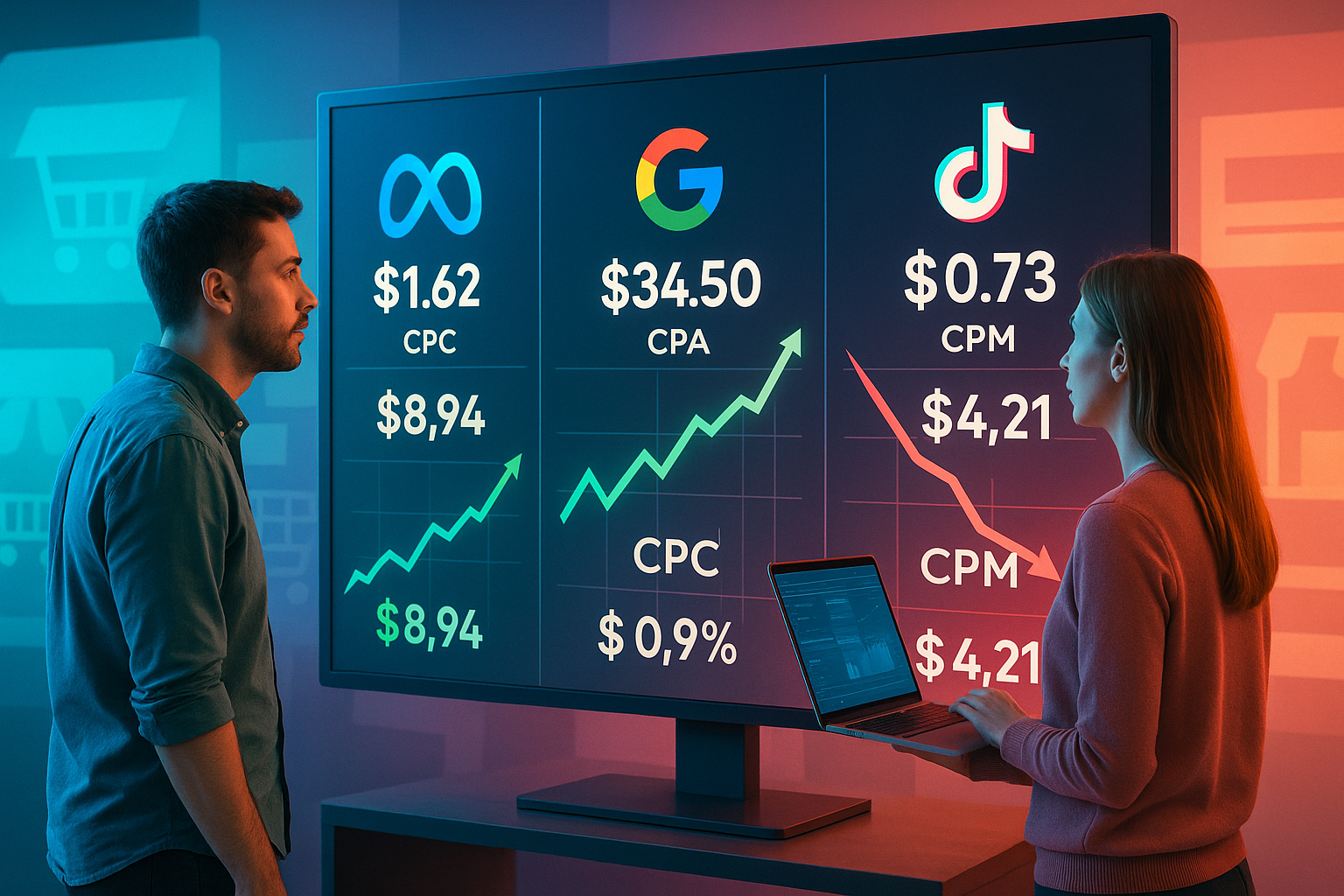
Two stores may sell the same sneakers, but the advertising system will still set different prices per click. Why? Because it’s not the products that are being advertised, but the context. Google, Meta, and TikTok evaluate the bid, ad quality, relevance, and user behavior in real time. It’s like a stock exchange, only instead of stocks, your banners are being traded.
The facts speak for themselves:
This means that even if you copy a competitor’s campaign pixel by pixel, you will pay a different amount because ad auctions respond to the day of the week, season, number of competitors, and even how many people are currently on TikTok. Therefore, the price of promotion changes along with the market, and there is no such thing as a “static” figure.
It’s one thing to increase brand awareness, and quite another to sell a specific product. Goals dictate completely different advertising purchasing logic:
In Europe, for example, the average CPM in Google Ads is €9.4, but the purchase price can range from €6 to €123 depending on the niche. It’s the same story in Ukraine: the more popular the category, the more expensive the traffic.
Now imagine that you are working with several audiences: one buys impulsively, and the other after three reminders, and the cost of contact with them is different.
Add to this Google’s algorithms, which are updated quarterly, and SEO, which doesn’t work instantly but takes several months, and you’ll understand why it’s so difficult to answer the question “when will I see results?”
We cannot quote a price without diagnostics because we do not know:
These are different goals, different logic, and different costs for the result.
Therefore, there is no fixed price list. There is a budget framework and a path we take to achieve results. But what really keeps costs under control is a personalized approach. We don’t take a “one size fits all” approach, but rather build your model: a quick website and analytics audit, niche hypotheses, quick channel and creative tests. Then we scale only what keeps the purchase price within the plan. This way, you don’t pay for impressions to the “wrong people” and don’t pour traffic into a format that doesn’t convert.
We work comprehensively: we plan channels as a single system with one goal — to bring a person to a purchase and bring them back again. This approach is based on channel synergy, smart budget optimization, sales and brand awareness growth, as well as analytics that constantly enhance results.
Channel synergy. Buyers move in waves: they see something, become interested, check it out, and buy it. That’s why we activate several tools at once and assign them roles:
Together, this is a direct path to the shopping cart. And this leads to the following conclusion: money should be invested wisely, not “wherever it goes.”
Budget optimization. We allocate the budget according to channel roles: where we generate demand, where we collect applications, where we push sales. Attribution based on data helps: we see the contribution of each step, we don’t overpay for repeated impressions to the same person, we test in short cycles and transfer money to where it works best.
Growth in sales and brand recognition. When people encounter us in several places, it is easier for them to trust and buy. Video opens doors, search closes deals, and marketplace builds confidence. Sales become more consistent, and dependence on auction fluctuations is reduced. To maintain this consistency, you need a transparent picture — from the first click to the repeat purchase. In other words, analytics.
Analytics and improved results for each channel. We set up a unified event scheme in GA4, collect our own audiences (first-party data), connect CRM, and monitor the frequency of impressions. And then — short A/B cycles. This way, each channel gives a little more every week than it did yesterday. And when the system counts honestly, the result in money is quickly felt.
Therefore, a comprehensive approach and proper promotion directly boost sales: we gradually generate interest, dispel doubts, and guide the buyer to the point of purchase.
Want an accurate assessment of your online store’s promotion and an effective growth strategy? Contact Cómon Agency and we will help you build a comprehensive promotion system that consistently drives sales today and grows your brand tomorrow.

 01.05.2023